
Last updated: October 2026. Prices and specs reflect what was listed on official sites at the time of writing and may have changed.
It’s 4:52 on a Tuesday. My last call of the day is running long, and somewhere on the other side of the office door a toddler has located an unattended phone with the precision of a heat-seeking missile. I know this because the house has gone quiet. Not nap quiet. Screen quiet. Which is exactly why I went down the Toniebox vs Yoto rabbit hole: two screen-free speakers that promise to give a small person something to do that doesn’t glow.
Here’s the honest version. It’s a constant battle these days to keep screens away from toddlers. Phones are everywhere, tablets are cheap, and every one of them is designed to be more interesting than whatever Dad is doing. And look — I don’t want to raise an iPad kid. Our house has landed on a ladder: the Little Tikes Story Dream Machine is our good compromise, and an audio-only player like a Toniebox or Yoto is the ultimate solution.
So I dug through the spec sheets, the support pages, the pricing fine print, and a frankly unhealthy number of parent complaint threads. This isn’t a hands-on torture test of either speaker. It’s the research, laid out by a dad, so you can make the call during nap time.
The Quick Verdict
- Under 3: Toniebox 2. It’s officially rated for ages 1+, the controls are squeeze-and-tap simple, and there are no cards to lose. On a budget? The Toniebox Lite.
- Ages 3 and up, and you want it to last into grade school: a Yoto Player. The 3rd Gen is the value play; the 4th Gen is the new flagship.
- Car trips, bath-adjacent chaos, puddles: the Yoto Mini 4th Gen, which is IP67 rated.
- Already own a Story Dream Machine? Keep it for story time and add an audio-only player for wind-down and quiet time.
Why Screen-Free Audio Matters (Without the Lecture)
I’m not here to wag a finger. But it helps to know what the actual guidance says, so here it is, word for word.
The American Academy of Pediatrics put out a new policy statement in January 2026, “Digital Ecosystems, Children, and Adolescents”. On little kids, it says:
“Infants do not learn from digital media, but occasionally viewing brief, high-quality videos (eg, Sesame Street) is not detrimental.”
American Academy of Pediatrics, 2026 policy statement
And on time limits:
“Time limits might range from <1 hour/d for toddlers and preschoolers to 1 to 2 hours/d or more of entertainment (not school-related) media for school-aged children and teens. The most important considerations are high-quality content and prioritizing healthy activities (eg, sleep, play, physical activity, reading).”
American Academy of Pediatrics, 2026 policy statement
The AAP’s own parent Q&A boils it down further: “AAP generally recommends less than one hour per day for toddlers and preschoolers.” (AAP Q&A)
The World Health Organization’s 2019 guidelines are stricter for the littlest ones:
“For 1-year-olds, sedentary screen time (such as watching TV or videos, playing computer games) is not recommended. For those aged 2 years, sedentary screen time should be no more than 1 hour; less is better. When sedentary, engaging in reading and storytelling with a caregiver is encouraged.”
World Health Organization, 2019
For ages 3 to 4, the WHO says: “Sedentary screen time should be no more than 1 hour; less is better.”
Now the guardrails, because I promised not to overstate this. Neither the AAP nor the WHO rates audio players or picture projectors. Nobody is saying a Toniebox counts as “reading with a caregiver.” And the AAP’s point is that content quality and healthy routines matter more than any stopwatch. Here’s my dad math, which is opinion, not medicine: a speaker can’t autoplay a video, can’t serve an ad, and can’t pull a kid into a scroll. If an hour is the ceiling, I would rather fill the rest of the afternoon with stories and songs than with a tablet I have to pry loose like it’s welded to his hands.
The Good Compromise: Little Tikes Story Dream Machine
Before the main event, a quick shoutout to the device that actually lives in our house. Our family owns the Little Tikes Story Dream Machine and we love it. It projects story pictures onto a wall or ceiling while the story plays out loud. (Heads up: Little Tikes rates it for ages 3 and up.) It’s pictures, not a tablet. No apps, no autoplay rabbit hole, no “one more episode.” Is it screen-free in the strictest sense? Not quite. That’s why I call it the compromise.
- Ages: 3 to 8, per Little Tikes.
- Power: 4 AA batteries. The ones in the box are for in-store demo mode, so put fresh ones in on day one.
- Projection: works from about 2 to 6 feet, with a focus ring.
- Extras: a night light, white noise sounds, buttons for volume, fast-forward and rewind, and side slots that hold three story cartridges.
- Price: starter sets run about $49.99 to $82.99 on Little Tikes’ site, and extra story collections are $14.99. The Amazon starter set linked above was about $49 when I checked.
The catch: it’s a darkened-room, sit-and-watch activity. An audio-only speaker goes wherever the kid goes: the floor, the car, the blanket fort. That’s why audio is the ultimate solution.
Toniebox vs Yoto: The Side-by-Side
Prices as of October 2026, from tonies.com and yotoplay.com list prices. Sales come and go.
| Toniebox 2 | Toniebox Lite | Yoto Player (3rd / 4th Gen) | Yoto Mini (2024 / 4th Gen) | |
|---|---|---|---|---|
| List price | $129.99 | $79.99 (with a Tonie) | $109.99 / $149.99 | $79.99 / $109.99 |
| Official age | 1+ | 1+ | 3+ | 3+ |
| Battery (claimed) | Up to 9 hrs | Up to 6 hrs | Up to 16 hrs | Up to 14 hrs / 16 hrs |
| Content | Figurines (Tonies) | Figurines (Tonies) | Cards + app | Cards + app |
| Night light | Light ring | No | Yes | No |
| Wake-up help | Sunrise alarm | No | OK-to-wake clock / cues | OK-to-wake clock |
| Headphones | Wired + Bluetooth | Wired + Bluetooth | Wired + wireless | Wired + Bluetooth |
| Build | Soft fabric | Hard shell, optional covers | Hard shell, optional jacket | Pocket-size; 4th Gen is IP67 |
Meet the Lineups
tonies
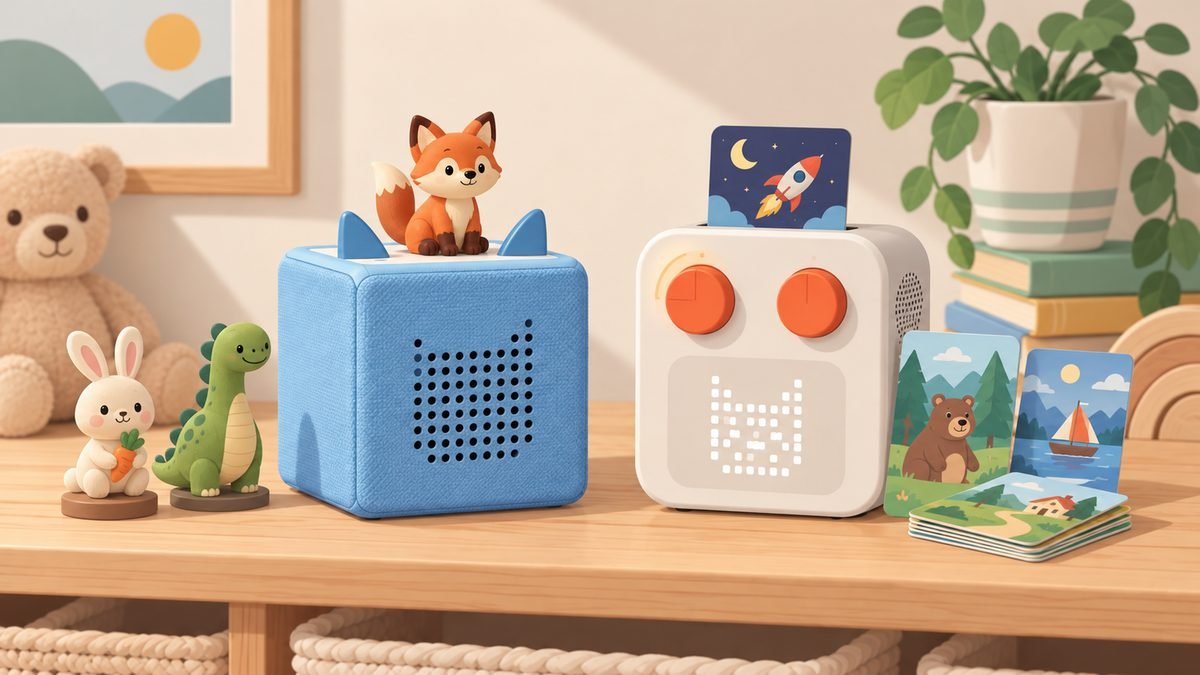
The Toniebox 2 ($129.99) is the squishy cube with ears. Put a Tonie figurine on top and it plays. Squeeze the ears for volume, tap the sides to skip. It has a light ring that doubles as a night light, a sleep timer, a sunrise alarm, a bedtime mode, and Tonieplay games. The Toniebox Lite ($79.99 with a figurine, new in the US this year) is the stripped-down version: hard plastic shell, up to 6 hours of battery, a sleep timer, but no light ring, no alarm and no games.
Yoto
Yoto runs on cards. Slot one in and it plays. Physical controls handle volume and skipping. Yoto just launched a new generation, so you’re choosing between the Yoto Player 3rd Gen ($109.99 list, with a night light, OK-to-wake clock and room thermometer), the brand-new Yoto Player 4th Gen ($149.99, on pre-order with shipping estimated from mid-October), the Yoto Mini 2024 Edition ($79.99), and the Yoto Mini 4th Gen ($109.99). Both 4th Gen players add 64 GB of storage and a Green Button that plays saved favorites without a card. One honest note: Yoto says a few 4th Gen features aren’t available just yet.
Figurines vs. Cards: The Real Decision
This is the whole fight. Everything else is details.
Tonies are toys. They’re chunky figures a one-year-old can grab, carry, line up and plunk on the box. For under-3s, look at My First Tonies ($14.99), which are soft and made for ages 1 to 3. Many classic Tonies carry a 3+ age label, so check the box. The downsides: most classic Tonies cost $19.99, most run 30 to 90 minutes, and by my math that works out to roughly $13 to $40 per hour of audio. They also take up real shelf space. Creative Tonies ($9.99) let you record up to 90 minutes of your own stuff, which is how a grandparent three states away gets bedtime duty.
Yoto cards are… cards. They’re thin, cheap to store, and there are a lot of them. Individual cards on Yoto’s store range from roughly $6.99 to $14.99, and Make Your Own cards ($17.99 for a 5-pack) let you link your own audio. Cards are also really easy to lose, bend, or post through the heating vent. Yoto’s own guidance is that kids under 3 should only use its cards or players with adult supervision.
The dad translation: a toddler can play with Tonies. A preschooler can manage Yoto cards.
Durability: Built for Drops, Drool and Juice Boxes
- Toniebox 2: a soft fabric shell, about as toddler-friendly as electronics get. The flip side: fabric soaks up whatever the toddler is eating.
- Toniebox Lite: a hard ABS shell, with silicone covers sold separately. It should wipe clean more easily than fabric.
- Yoto Player: a hard shell with an optional Adventure Jacket ($29.99). It’s more of a nightstand device than a throwing toy.
- Yoto Mini 4th Gen: the toughness pick on paper. It’s rated IP67 for water and dust, has liquid detection, and Yoto says it was drop-tested 30,000 times. Somewhere a Yoto engineer has a very sore arm.
Bedtime Features
If the speaker is going to live in the kid’s room, this section matters most.
- Toniebox 2: a light ring that works as a night light, a sleep timer with light, a sunrise alarm, and a bedtime mode.
- Toniebox Lite: a sleep timer only. No night light, no alarm.
- Yoto Player: a night light plus an OK-to-wake clock on the 3rd Gen. The 4th Gen gets an LED night light panel and okay-to-wake cues, with separate day and night favorites on the Green Button.
- Yoto Mini: an OK-to-wake clock and sleep sounds on the 2024 Edition, but no night light on either Mini.
Already running a sound machine? You may not need a speaker to double as one. My honest take is in do you actually need a baby sound machine, and the picks are in our best baby sound machine guide.
WiFi, Apps and Parental Controls
Both brands use an app and need WiFi up front. tonies says WiFi is needed for setup, for the first play of each new Tonie, and for new Creative Tonie recordings. After that, downloaded Tonies play offline. Yoto works the same way: each card downloads over WiFi on its first play, then lives on the player.
- tonies app: set a max volume, the sunrise alarm, light brightness and sleep timers. 1+ mode locks down some features for the littlest users.
- Yoto app: separate day and night volume limits, headphone volume limits, and day and night modes. It’s more knobs to tweak, which suits a parent who likes settings.
- Privacy: Yoto advertises “No microphone. No camera. No ads.” Neither brand runs a video screen.
For WFH parents, here’s the sneaky benefit. Both brands support headphones, so story time doesn’t have to leak into your 2 p.m. call. It’s one more layer in the kids interrupting work calls defense system. Pair that with a good set of noise-cancelling headphones on your end, and the house becomes two separate sound zones.
What It Actually Costs in Year One
Prices as of October 2026, at list price. Example: the speaker plus five stories.
| Setup | Speaker | 5 stories | First-year total |
|---|---|---|---|
| Toniebox 2 + 5 classic Tonies | $129.99 | $99.95 | $229.94 (+ a USB-C wall adapter, often sold separately) |
| Toniebox 2 + 5 My First Tonies | $129.99 | $74.95 | $204.94 |
| Toniebox Lite set + 5 classic Tonies | $79.99 (includes 1 Tonie) | $99.95 | $179.94 (+ a USB-C cable, not included) |
| Yoto Player 3rd Gen + 5 cards | $109.99 | $34.95–$74.95 | $144.94–$184.94 |
| Yoto Player 4th Gen + 5 cards | $149.99 | $34.95–$74.95 | $184.94–$224.94 |
| Yoto Mini 2024 + 5 cards | $79.99 | $34.95–$74.95 | $114.94–$154.94 |
| Yoto Mini 4th Gen + 5 cards | $109.99 | $34.95–$74.95 | $144.94–$184.94 |
Optional extra: Yoto Club membership runs $39.99 to $169.99 a year depending on the tier. The Explorer tier ($4.99 a month or $39.99 a year) includes a library of audio, and the higher tiers add monthly credits for cards. Those credits expire after 12 months, so don’t hoard them like Halloween candy. Yoto has also had big sales lately (the 3rd Gen Player was marked down on Yoto’s site when I checked), so price-watch before you buy.
The Complaints Parents Actually Have
tonies:
- The figurines add up fast, and some stories run short for $19.99.
- Storage. A Tonie collection eventually needs its own shelf, then its own zip code.
- Battery and charging gripes show up in parent forums. One r/TonieboxUSA thread is literally titled “Completely fed up with defective batteries.”
- The power accessories are separate: the Toniebox 2 usually needs a wall adapter, and the Lite doesn’t include a cable.
Yoto:
- Lost and bent cards. This is the number-one complaint, by a mile.
- It’s fiddlier for under-3s. The cards and knobs make more sense once fine motor skills catch up.
- WiFi and setup hiccups come up regularly in parent threads.
- Club credits expire, and some 4th Gen features are still marked “coming soon.”
Which One for Which Kid?
Here’s how I’d settle Toniebox vs Yoto for your house:
- The 1-to-2-year-old grabber: Toniebox 2 with My First Tonies. Squeeze, plunk, done.
- The budget toddler setup: Toniebox Lite. You give up the night light and alarm but keep the figurine magic.
- The 3-to-8-year-old story binger: Yoto Player. Cheaper content, 16-hour battery, and it grows into podcasts and chapter books.
- The road-trip and puddle kid: Yoto Mini 4th Gen. It’s small, waterproof, and drop-tested.
- The Dream Machine family: keep the projector for story time and add audio for quiet time and the car.
FAQ
Is Toniebox or Yoto better for a 2-year-old?
On paper, Toniebox. It’s officially rated for ages 1+, the figurines are easier for small hands than cards, and My First Tonies are designed for ages 1 to 3. Yoto rates its players for ages 3 and up and says younger kids should use them with adult supervision.
Do Toniebox and Yoto need WiFi?
For setup and for the first play of new content, yes. After a Tonie or card has downloaded, both play offline, which is great for car rides.
Are Toniebox and Yoto good screen-free toys for toddlers?
They’re audio-only, with no video screen and no ads, so they’re a strong pick for parents looking for toddler screen time alternatives. Just know that neither the AAP nor the WHO specifically evaluates audio players.
Is a Yoto Club subscription required?
No. Cards you buy play without a membership. The Club is optional and adds included audio or monthly credits.
Can I record my own stories?
Yes. Creative Tonies ($9.99) hold up to 90 minutes of recordings, and Yoto’s Make Your Own cards let you link your own audio.
Should I get the Yoto 3rd Gen or 4th Gen?
If the 3rd Gen is on sale and you don’t need 64 GB of storage or the Green Button, it’s the value pick. If you want the newest hardware and can wait for the remaining features to roll out, go 4th Gen.
The Bottom Line
The Toniebox vs Yoto call mostly comes down to age. For the toddler years, the Toniebox 2 is the safer bet. For a preschooler you want to carry into grade school, the Yoto Player is the smarter buy. Either way, it’s one less glowing rectangle in the house. Set it up during nap time. Hide the charger from the dog.
Gesundheit.